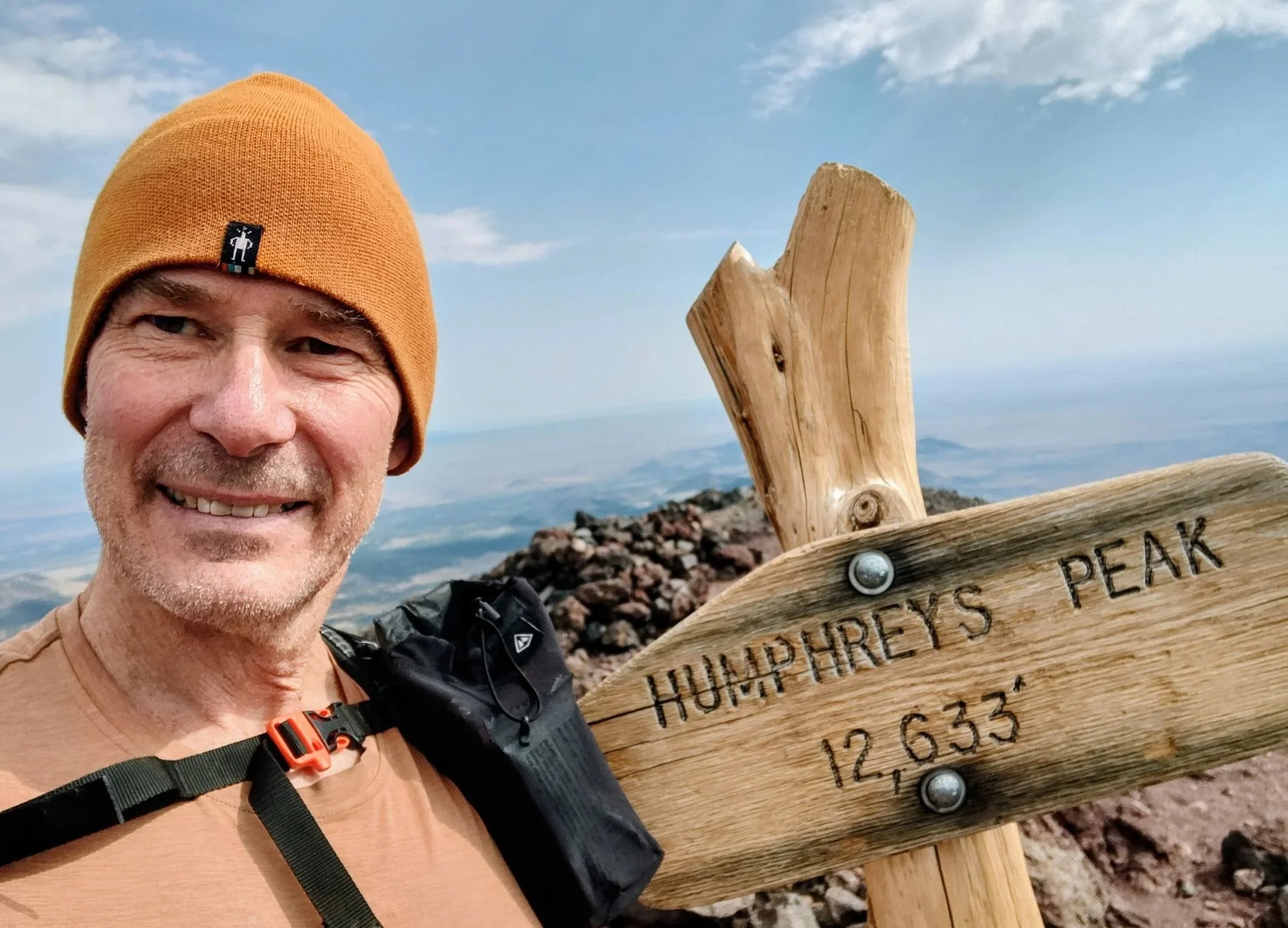
Summit of Humphreys Peak
When I came to Flagstaff this summer, I had one goal in mind: use Mount Humphreys as the foundation of my training.
I didn't rush back to the summit. After my hip replacement, I spent the first few hikes turning around before reaching the top, simply to see how my body responded. Each climb was less about reaching the summit and more about rebuilding trust.
Eventually I began climbing all the way to the top.
My first full ascent took about six hours and twenty minutes. With each successive climb, the time came down a little. I wasn't trying to set records. I was trying to find a sustainable rhythm that I could repeat.
For every ascent, I used nasal breathing as my governor. Rather than chasing a pace, I let my breathing determine how hard I worked. If my breathing became strained, I backed off. If it stayed smooth, I kept moving.
The result surprised me.
My fifth and sixth ascents were separated by five days. Over a hike lasting more than five and a half hours, the difference in total time was only twenty-seven seconds. Even more interesting, my average heart rate differed by just one beat per minute.
Those numbers aren't remarkable because they're fast. They're remarkable because they're repeatable.
To me, they suggest that nasal breathing wasn't simply limiting my effort—it was regulating it. By allowing my breathing to set the pace instead of my ambition, I arrived at almost exactly the same performance twice.
The mountain wasn't asking me to go faster.
It was asking me to become more consistent.
For me, this was strong evidence that nasal breathing served as an effective governor for pacing. It didn't guarantee a perfect performance, but it consistently guided me toward a sustainable one.
That may be the most valuable lesson Mount Humphreys gave me this summer.