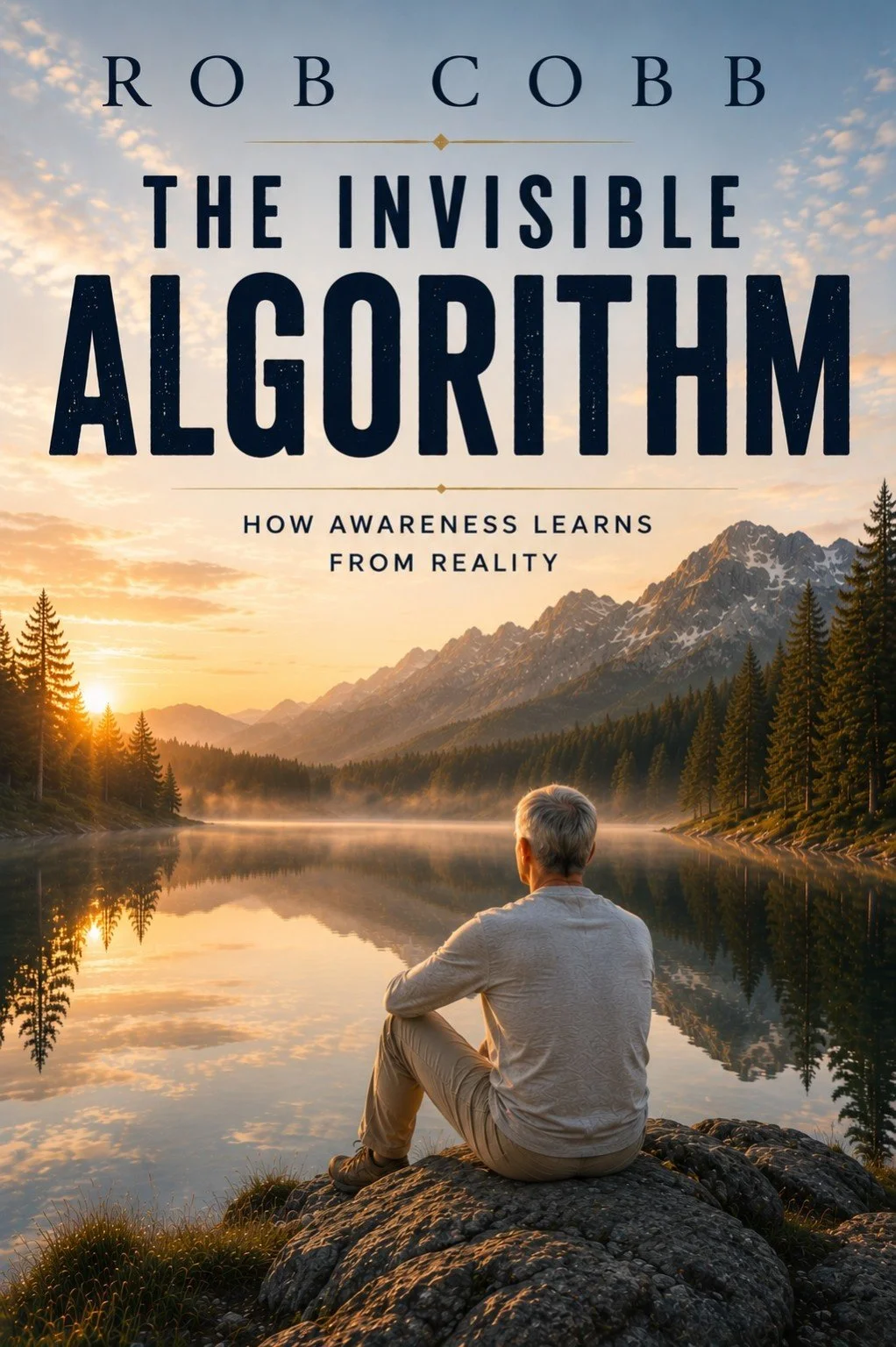
People have asked me why I wrote The Invisible Algorithm. I didn't write it to convince anyone of anything. I wrote it because I needed to make sense of forty years of observations.
For 40 years, I collected thousands of small observations about attention, awareness, fear, decision-making, climbing, endurance, and what it feels like to be alive. I never knew how to arrange them into a coherent architecture. They were scattered pieces of a puzzle I couldn't quite assemble.
Writing the book wasn't an exercise in teaching. It was an attempt to organize decades of scattered observations into the most coherent framework I could build. Somewhere in that process, I realized I wasn't simply writing down what I believed—I was discovering what I believed. By the time I reached the final page, I understood those ideas more clearly than when I had begun.
The book became less a collection of thoughts than an architecture that finally made sense of forty years of questions.
I also knew, from the very beginning, that this book would not be for everyone.
The Invisible Algorithm asks questions about how we experience reality and how awareness learns. I expect some readers to connect with it deeply, others to disagree completely, and many to decide it's simply not the kind of book they're looking for.
And that's okay.
Keeping those ideas to myself would have been safer. Publishing them was an acknowledgment that understanding grows through conversation, not isolation.
One of the values I've tried to live by is to live bravely.
To me, that doesn't just mean climbing mountains or taking physical risks. It also means being willing to say, “This is the best understanding I've reached so far,” knowing that people may disagree, criticize it, or point out flaws I hadn't considered.
If an idea can't withstand honest criticism, then I want to know why.
So I don't fear thoughtful criticism—I welcome it. Not because I expect everyone to agree with me, but because the search for understanding is more important than protecting my ego.
Whether The Invisible Algorithm ultimately resonates with ten readers or ten thousand, I hope it starts a conversation. If it causes someone to look a little more carefully at their own experience, or if it challenges my own thinking through thoughtful disagreement, then the book has already done something worthwhile.
Sometimes the bravest thing we can do isn't to defend what we believe.
Sometimes it's simply to say, “This is what I see,” and be willing to listen to what others see in return.